tel
Enquiry
Home

La requête en ligne

close
Emplacement actuel: Accueil Solution R&D

CustomizationProcess

  • Requirement communication provides solutions

    Requirement communication provides solutions

  • Clearly define the requirements and sign the contract

    Clearly define the requirements and sign the contract

  • Product sampling and sample acceptance

    Product sampling and sample acceptance

  • Batch production product testing

    Batch production product testing

  • Product delivery customer acceptance

    Product delivery customer acceptance

  • Technical support and after-sales service

    Technical support and after-sales service

La demande est personnalisable

👋 Nous proposons les services de personnalisation suivants de type OEM et ODM : 1) Les câbles d'alimentation, les cordons secteur AC et les connecteurs peuvent être intégrés à des longueurs variées aux entrées et sorties ; 2) Options concernant le design, les couleurs, les étiquettes et les logos ; 3) Emballage sur mesure.

Discutez avec nous

Catégorie de produit

Huit niveaux de protection pour une sécurité sans souci

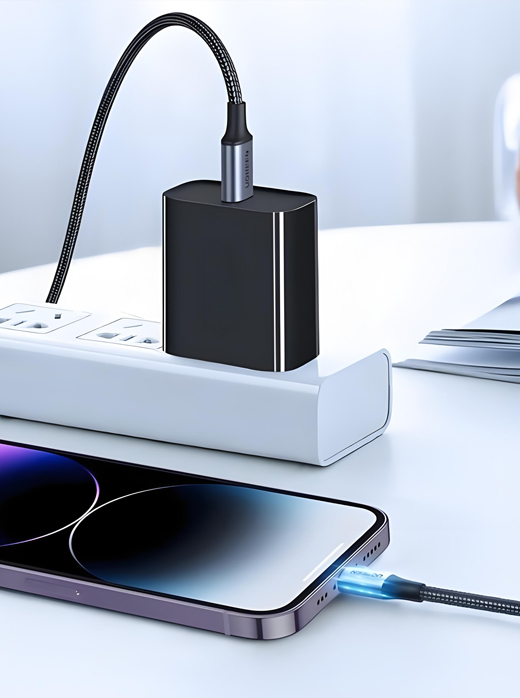
Le chargeur Gu Baite prend en charge : protection contre les surtensions, protection contre les surintensités, protection contre les courts-circuits, protection contre les sous-tensions, protection contre les surtempératures, protection contre les surcharges, protection anti-refoulement, protection antistatique, assurant une utilisation plus sûre

Nos atouts

Appareils de communication

Appareils de communication

Service d'assistance technique personnalisé par ingénieur disponible 24 heures sur 24 et 7 jours sur 7 ; Service porte-à-porte le jour même dans la région du Delta de la Rivière des Perles ; Service de maintenance de trois ans en cas de problèmes de qualité

Afficher les détails+

Honneurs de l'entreprise

close

Questions fréquemment posées

What is the difference between PD and QC?

The difference between USB interfaces is that PD fast charging is a charging protocol that belongs to the USB TYPE C interface and can only be used for USB type C interfaces. QC fast charging: Common Android Micro-B, USB type A, and USB type C interfaces. 2.2. The communication recognition channel of the fast charging is inconsistent. PD fast charging is not recognized through the communication protocol of D+, D -. Note: PD fast charging is not recognized through the communication protocol of D+, D -. PD fast charging is recognized through CC pin communication. QC3.0/QC2.0 are identified by synchronous D+and D - communication protocols. The Micro-B is also designed to distinguish between the two fast charging devices. In the USB type C interface, there are also D+and D pin pins. The USB type C can be used as a dual compatible product for PD and QC fast charging. Micro-B and USB TYPE A can only use QC3.0/QC2.0 protocols. 2.3. Differences in charging power for power supply: QC3.0/QC2.0 fast charging is the earliest high-voltage fast charging protocol, with a charging power of generally 18W and a maximum charging power of 30W. PD fast charging is currently the most comprehensive fast charging protocol, and PD3.0 can support a maximum power of up to 100W. PD3.1 currently supports a maximum power of 140W.

Why do domestic brands such as Huawei support super fast charging

Domestic brands such as Huawei and OPPO are private agreements and not open to the public. In addition to authorized manufacturers of mobile phone brands or original chargers, it can support maximum power charging of mobile devices. Other non original chargers cannot support maximum power charging of the phone, and the charging time will be longer.

What are the advantages of gallium nitride chargers?

Gallium nitride chargers are mainly charging devices that use gallium nitride as an important raw material. Compared to mobile phone chargers that previously used "silicon" as an important raw material, their biggest advantage lies in their smaller size, stronger output power, and more environmentally friendly and energy-saving.The advantages of gallium nitride chargers are small size and safety. Compared with ordinary semiconductor silicon materials, gallium nitride has a wider bandgap and good thermal conductivity, which can match smaller transformers and high-power inductors. Therefore, gallium nitride chargers have advantages such as small size, high efficiency, and more safety.